
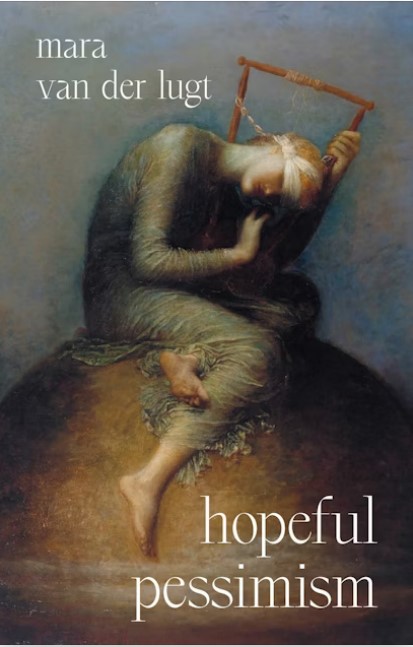
 J'en avais lu l'annonce de parution sur le site de son éditeur: Princeton University Press grâce à un article que l'autrice avait rédigé en néerlandais pour la revue hebdomadaire De Groene Amsterdammer (N°10 2025). J'en ai ensuite lu un compte-rendu précis & élogieux avec réserve dans la revue trimestrielle New Humanist (Daniel Callcut explores the upside of pessimism), une des nombreuses revues dont le facteur BPost alimente ma boite aux lettres. La commande passée auprès d'un libraire principautaire mit à peine une semaine pour attendre mon enlèvement (sans Sabines). En voici, la table des matières étoffée à laquelle j'ai ajouté les intertitres omis par la maison d'édition alors que l'autrice en a intelligemment pourvu son introduction & chacun des neuf chapitres:
| Page | Part | Numéro de chapitre | Titres du chapitre | Intertitres |
| xiii | Introduction | |||
| xvi | The misunderstanding | |||
| xix | The danger | |||
| 1 | I Pessimism | |||
| 3 | 1 | Optimism, pessimism, fatalism | ||
| 4 | A brief tour | |||
| 6 | Value oriented | |||
| 9 | Future-oriented | |||
| 11 | A duty of optimism? | |||
| 14 | fatalism | |||
| 17 | Climate optimism, climate pessimism | |||
| 23 | 2 | Pessimism and activism | ||
| 25 | Albert Camus | |||
| 33 | Climate barbarism | |||
| 37 | The danger of optimism | |||
| 44 | The value of pessimism [Jeremy Corbin] | |||
| 47 | 3 | Losing the future | ||
| 54 | Encountering the abyss | |||
| 61 | The labyrinth | |||
| 65 | II Hope | |||
| 67 | 4 | The ambiguity of hope | ||
| 72 | Hope's history | |||
| 80 | A thing with shadows | |||
| 85 | Rethinking hope | |||
| 91 | 5 | Radical hope revisited | ||
| 98 | Radical hope & climate change | |||
| 109 | Climate hope | |||
| 117 | 6 | Blue hope | ||
| 124 | The two hopes Andir & Estel [Tolkien's Lord of the rings] | |||
| 130 | Green hope | |||
| 135 | Blue hope [V. Havel] | |||
| 141 | "It had to be done" | |||
| 145 | Hope without expectancy | |||
| 149 | III Our ladies of sorrow | |||
| 151 | 7 | Our lady of tears: on grief | ||
| 153 | Grief & mourning | |||
| 158 | Mourning & melancholia | |||
| 166 | The gift of climate grief | |||
| 169 | 8 | Our lady of sighs: on despair | ||
| 171 | The other side of despair | |||
| 179 | Desperate resistance | |||
| 184 | 9 | Our lady of darkness | ||
| 185 | Dark epiphanies | |||
| 192 | The virtue of pessimism | |||
| 197 | Hope's arrow | |||
| 199 | [last page of text] | |||
| 201 | Ackowledements | |||
| 203 | Notes, oh precious notes ! | |||
| 231 | Bibliography | |||
| 243 | Illustrations | figures & color plates |
Il me semble que, complémentairement à cette table des matières étoffée, cela puisse faire sens de constituer un réservoir des neuf dernières phrases des neuf chapitres aux fins de conserver trace de ma lecture attentive de cet ouvrage dont je perçois la force de frappe pour (me) sortir de la dichotomie espoir/déception dont j'entrevois depuis quelque temps la limite philosophique pour affronter le réel qui nous contraint en nous étreignant à la gorge sans jamais encore avoir pu saisir une possible/potentielle sortie par le haut de ce qui me semblait être une voie sans issue.
L'étreinte,
toute l'étreinte
est-elle
une contrainte ?
Contrarie-t-elle
notre existence même
dans cette contrée
présentement présente ?
Sa présence même,
nonobstant ces contraintes,
constitue-t-elle
en soi – càd en moi aussi –
la matière même de cette
troisième voie potentielle
que constitue
le pessimisme plein d'espoir,
voire un pessimisme prometteur ?
Et c'est ici, bardaf !, que prend pied l'abysse qui sépare l'élégante souplesse néologique de l'anglais, ma langue de culture, face à la raideur de ma langue maternelle. C'est tellement mieux dit Hopeful pessimism que pessimisme plein d'espoir. & pourtant... Une étude terminologique entreprise par mes soins permet peut-être de me sortir de cette confusion en me mettant dans les pattes l'adjectif prometteur. Un pessmisme prometteur .?
Bon les dernières phrases donc, en attendant de me relever de cette bardaferie terminologique & notionnelle:
ch1: « In an age of climate crisis & ecological devastation pessimism has a role to play. »
ch2: She argues that « the real enemy to be combatted is not... & is not... but any stance of looking away & giving up, i.e. the stance of inertia. »
ch3: « Sometimes the paths that look most promising have hidden traps & falls, and it is not different here [= in climate change] – for while neglecting the future has its dangers, so too has overstressing the future at the expense of the present & it is the same with hope. »
ch4: « If anything, hope is a concept that needs to be handled with infinite caution [she doesn't write care but caution], as false hope can devastate like few (things can, & disappointed hope leads to bitterness. What price hopelessness, indeed ? as China Miéville asks. But what price hope ? »
ch5: « But in this day & age, radical hope or even just indeterminate hope, should not be invoked too quickly to guide our moral [responses] & practical responses to a disaster that is still very much underway because, at this point in time, we know exactly what to hope for. And we know what to do. » But we don't do it, mutters my own self after typing this very last sentence.
ch6: « It is a blue register of hope, one that remains open even in extreme uncertainty & at the final desolation – a hope compatible with grief, pain, fear, and all the sorrows of a darkened age. »
ch7: « Thay grief, like the pity for the Crow, is "an emotion appropriate to the gods". This is the gift of our Lady of Tears. »
ch8: « That despair, like anxiety, "means you're paying attention". That despair, like hope, can serve to "shove you out the door". This is the gift of Our Lady of Sighs. »
ch9: « And so it is time to turn the page on hopeful pessimism, and do the work. For duty, for justice, for truth, for thos who are already suffering, and those who will come after us, for humans and for other species, for solidarity, for the frail lives beside us and the dark earth beneath us – in the knowledge that you, that I, have answered the call. »
Il me faut encore vous dire que l'autrice, qui enseigne à l'Université de St Andrews en Écosse - une des meilleures au monde ! - a élu un peintre en tant que présentateur d'une oeuvre qu'elle a précisément choisie pour sa portée symbolique. Le peintre, inconnu jusqu'il y a peu à mon bataillon artistique, s'appelait G. F. Watts (1817-1904). J'aime assez cet appui artistique amené en soutien d'un concept qui prend son temps pour se déployer. J'y retourne d'ailleurs...
[31.08.25] Alors que l'ouvrage se concentre uniquement sur le dérèglement climatique comme source de préoccupations, l'essai en néerlandais que l'autrice a confié à l'hebdomadaire De Groene Amsterdammer en son n°10 de 2025 nous montre qu'une attitude de pessimisme plein d'espoir convient également pour affronter l'extrême droite (la montée en puissance de Geert Wilders et de son parti raciste dans son pays d'origine, les Pays-Bas), le trumpisme et ces guerres qui frappent d'effroi des millions de personnes innocentes un peu partout sur la planète: en Israël, au Soudan, en Ukraine, etc. malheureusement...
Les deux sources, le livre et l'essai, contribuent donc à universaliser l'approche philosophique innovante comme réaction adéquate face aux dérèglements multiples auxquels notre planète fait face. C'est la raison pour laquelle j'ai décidé d'entreprendre la traduction de l'essai en français parallèlement au résumé des apports nombreux de cette troisième voie qui pourrait nous aider à mieux répondre aux défis qui nous rongent à la fois de l'intérieur et de l'extérieur.
16 9 25 Vincent Rochelle consacre une recension à l'ouvrage sur La vie des idées.
Cette mise à jour-ci (22 1 26) consiste au signalement d'un article long publié dans The London Review of Books écrit par un politiste canadien travaillant à L'université anglophone canadienne "Simon Fraser" dans le département de géographie: l'auteur a pour nom Geoff Mann et se présente ainsi sur le site de l'université qui l'emploie:
Geoff Mann: « I am not trained as a geographer, but I am extremely fortunate to have ended up in geography, and at SFU geography in particular. My research, writing and teaching sit at the intersection of political economy, political theory, and the history of ideas. Right now, my focus is on uncertainty, whether it be scientific, expectational or existential. I am trying to understand the ways people deal with the uncertainties that characterize this moment, from probabilistic models to religious commitments to semiautomatic weapons in the garage. I spend a lot of my time thinking about climate change, macroeconomic crisis, and far right/fascist politics, but I am just as interested in the concept and politics of emergency/crisis in contemporary capitalist societies—what it means, how we know one when we see one, and what kinds of things we think we can or cannot do about it.
Over the years have written 5 books (and edited another) and a number of academic articles on everything from climate economics to country music, all of which have a political economy + political theory focus. More recently I have been writing fairly regularly for the London Review of Books, the New York Review of Books, Dissent, the New Statesman, and a few other outlets. In addition to my position here at SFU Geography, I am also an Associate Member of the SFU School of Public Policy and a Senior Fellow at the Institute for New Economic Thinking in New York City, and have been very lucky to be a resident at the Banff Centre for the Arts in 2016, a Guggenheim Fellow (2022-2023) and a member of the Institute for Advanced Study in Princeton (2023-2024). » source https://www.sfu.ca/geography/about/our-people/profiles/Geoff-Mann.html
« Je n'ai pas de diplôme de géographe, mais j'ai beaucoup de chance d'avoir atterri en géographie, & dans le département de géographie de cette université en particulier. Mes recherches, mes écrits et mon enseignement se situent à l'intersection de l'économie politique, la théorie politique et l'histoire des idées. Pour le moment, mon centre d'intérêt tourne autour de l'incertitude, qu'elle soit scientifique prévisionnelle ou existentielle. J'essaie de comprendre les façons dont les gens se débrouillent avec les incertitudes qui sont au coeur de ce moment, depuis des modèles probabilistes jusqu'aux engagements religieux ainsi que les armes semi-automatiques stockées dans le garage. Je passe beaucoup de temps àréfléchir au changement climatique, à la crise macroéconomique et la politique d'extrême droite/fasciste, mais je m'intéresse aussi tout autant au concept et à la politique de l'urgence/c rise dans les sociétés capitalistes contemporaines – ce que cela signifie, comment nous en reconnaissons une quand nous la rencontrons, et ce que nous pensons que nous pouvons ou ne pouvons pas y faire "là contre".
Au fil des ans, j'ai écrit cinq livres (et j'ai été l'éditeur d'un sixième) ainsi qu'un nombre d'articles académiques sur un peu tout allant de l'économie du climat, la musique country et tout ce qui a trait à un ancrage d'économie politique+ théorie politique. Plus récemment, j'ai écrit régulièrement des articles pour la London Review of Books, la New York Review of Books, Dissent, Le New Statesman and quelques autres; En plus de mon poste dans le département de Géographie de la SFU, je suis aussi un membre associé dans l'école de politique publique (ici aussi) et ai été un SENIOR FELLOW à l'Institut pour la réflexion sur la nouvelle économie, et j'ai eu beaucoup de chance d'être accepté comme résident au Centre Banff pour les arts, au musée Guggenheim en 2022-2023 et mebre de l'institu pour les études avancées de Princeton (2023-2024).
Je considère que son analyse des apports de HOPEFUL PESSIMISM donne à l'ouvrage sa pleine mesure; j'aurais voulu avoir pensé tout ce qui y est dit; cela n'est pas le cas. Dès lors the next best thing I can do is to let you read it !
L'article en question est une recension de deux ouvrages, dont celui de Mara van der Lugt. Il s'intitule "Good failures" (Échecs - pas le jeu, l'antonyme de réussite ! ) Voici le texte que j'extrais de The London Review of Books.
« ... the general sense is that we must not ‘give in’ to despair or doubt, indeed that it would be a moral failure to do so.
Mara van der Lugt’s Hopeful Pessimism is an extended dismantling of this common sense. It is a book of political philosophy addressed, maybe more narrowly than she intends, to self-identified climate activists. Van der Lugt’s principal claim is that in a ‘breaking world’ like ours, pessimism is completely justifiable and not the obstacle to action the climate movement believes it to be. Pessimism is not fatalism, and ‘from the pessimistic premise the defeatist conclusion does not follow.’ On the contrary, she says, one of the biggest problems with the ‘fatalistic optimism’ of mainstream climate politics is that when the ‘win’ fails to arrive – which so far has been most of the time – what adds to the disappointment is ‘the burden of being responsible for it’. Worse still, ‘the repression of negative, pessimistic, even desperate counter-narratives is truly dangerous, as it charges the already burdened with the duty of optimism.’
... Le sens général [du premier ouvrage recensé] est que nous ne devons pas "céder" au désespoir ou au doute, que ce serait en effet un échec moral de procéder ainsi.
Hopeful pessmism de Mara van der Lugt est un décorticage en règle très poussé de ce bon sens. Il s'agit d'un ouvrage de philosophie politique qui s'adresse peut-être plus étroitement qu'elle n'en avait l'intention, à des activistes climatiques auto-proclamés. Le message principal de van der Lugt est que dans un monde qui s'effondre comme le nôtre, le pessmisme se justifie pleinement et ne constitue pas un obstacle à l'action à laquelle le mouvement en faveur du climat croit. Le pessimisme n'est pas le fatalisme et " à partir d'un présupposé pessimiste, la conclusion défaitiste n'en découle pas." Au contraire, dit-elle, un des plus gros problèmes avec l'optimisme fataliste de la politique climatique du plus grand nombre est que quand la victoire fait défaut - ce qui jusqu'à présent s'est produit la plupart du temps - cela ajoute à la déception au fardeau d'en être responsable. Pire même, "la répression de contre-narratifs négatifs, pessimistes et même désespérés est vraiment dangereuse, puisque cela surcharge le fardeau déjà présent du devoir d'optimisme."
Van der Lugt bases her claim on a range of historical experiences (Jewish resistance during the Holocaust; Indigenous peoples devastated by colonialism; the campaigns of climate activists such as Greta Thunberg) and on the thinking of Albert Camus, Václav Havel and Cornel West, among others. In each case she finds support for her argument that to be a pessimist is not to be without hope. It is to sustain a sense of hope different from the simple ‘positivity’ we are usually prescribed. Taking her cue from the two versions of the painting on her book’s cover – George Frederic Watts’s Hope (1885-86), the first with a green background, the second with a blue – she gives the name ‘green hope’ to the ‘crude optimism’ of Camus’s ‘realists’, who are ‘willing to undertake only the tasks that succeed’. What we need instead, she says, is ‘blue hope’, a ‘restless hope’ that acknowledges the radical uncertainty of our moment and ‘draws its strength precisely from what we don’t know’. It is ‘not oriented on outcomes in the way that green hope is but finds value in commitment regardless of effect’. Her goal is to uncouple hope from impossible guarantees of success, and to propose an ethical basis for action in a world that might not have a future: to make political commitment meaningful, in other words, no matter what is on the horizon.
Van der Lugt fait reposer son message principal sur des expériences historiques (la résistance juive pendant l'Holocauste; des peuples indigènes dévastés par le colonialisme; le campagnes menées par des activistes du climat comme Greta Thunberg ainsi due sur les réflexions d'Albert Camus, Vaclav Havel & Cornel West, entre autres. Dans chaque cas, elletrouve de quoi appuyer son argument qu'être un.e pessimiste ne signifie pas être sans espoir. Cela consiste à attribuer un sens à l'espoir différent de la simple "positivité" que nous nous voyons habituellement prescrire. Repérant un indice dans les deux versions de la peinture sur la jaquette de son livre – Espoir de George Frederic Watt (1885-86), la première avec un fond vert, la seconde avec un fond bleu –, elle attribue le nom espoir vert à l'optimisme cru des réalistes de Camus, qui souhaitent entreprendre les seules tâches qui réussissent." Au lieu de cela, ce dont nous avons besoin, dit-elle, c'est d'espoir bleu, un espoir intranquille qui reconnait l'incertitude radicale de notre époque et "tire sa force précisément de ce que nous ne savons pas". Il n'est pas orienté sur les résultats à la manière de l'espoir vert, mais prend sa valeur de son engagement quel que soit l'effet. Son but est de découpler l'espoir d'impossibles garanties de succès, et de proposer une base éthique pour agir dans un monde qui pourrait ne pas avoir de futur: pour rendre l'engagement politique important en d'autres termes, peu importe ce qui se pointe à l'horizon.
Though she herself doesn’t go in this direction, van der Lugt’s book can help us think not only about the future of social movements, but about their pasts too. It is especially helpful when it comes to the endless post facto indictments of this or that effort’s ‘failure’: the failure to prevent the rise of the far right, the failure to prevent ecological destruction, the failure to win over the electorate to social democracy. As with the insistence on hope, these judgments are directed at those who are bothered enough to care in the first place. If you want to demoralise a movement, it seems to me, insisting that the past is cluttered with failures is a good way of going about it. It is plainly untrue that victory or success is always there to be had, as if ‘the people’ are naturally progressive and every lost election is proof of the left’s failure to convince them. Why do progressives, who justifiably insist on the power of money, media, history and structural forces, often seem to believe it should be easy to overcome these things?
Most of the time, politics is a long, slow scramble up the scree slope of history. As the climate crisis deepens, we don’t have time for that, which is one reason it makes sense to be pessimistic. But there is enormous political potential – and hope as well, though I am not sure which colour – in the fact that it can take a very long time for some things to matter, and even then it’s often in unexpected ways. It is almost impossible to know what will or won’t make a difference in the end, what seemingly failed efforts will be built on in the future. We need to experiment with new ways of thinking and doing, some of which won’t work out. Will these too be deemed failures? Or will they be welcomed as contributions to the work of building a different future, helping us learn what to do and what not to do?
I expect van der Lugt would agree with my elaboration on her argument. But it doesn’t sit easily with her emphasis throughout Hopeful Pessimism on politically motivated ‘duty’ and ‘right conduct’ rather than consequences. In an ‘age of sorrow’, pessimism, she says, is a virtue. Those who demonstrate a ‘hopeful, activistic pessimism’ – Thunberg, West, Rebecca Solnit, Naomi Klein and Jane Goodall all feature prominently in the book – are ‘moral exemplars’. This is old-school virtue ethics: she uses the Aristotelian term phronimos, referring to those skilled in the exercise of the virtues. These charismatic activists – who ‘know what we have to do’ and do it ‘because it is the right thing to do’ – are heroic figures who light the way.
The contributions of these people to the fight for social and climate justice are enormous. But Thunberg, West and Klein can be put on pedestals only because they are not representative of climate activists generally, let alone the public. Hopeful Pessimism reads like a book for and about such figures less than one for and about the public – the people who are most vulnerable to ‘green hope’. Is it possible to motivate a movement or political action that does not hinge on heroes?
‘If you do not have the courage to be where the crisis is, where the catastrophe is,’ van der Lugt quotes West, ‘you will never be changed.’ I have no idea whether that is true. Either way, it gives you a sense of the ‘costly’ virtue of hopeful pessimism. Most people do not take themselves to be activists. According to van der Lugt, that is a dereliction of duty. In the face of climate catastrophe, she asks, ‘how can we not grieve?’ But only the already grieving will hear that cry. Would you join a movement if its pitch was that it is a moral failing not to be part of it already? It would be too glib to say that pessimism, however hopeful, needs to be more fun. Van der Lugt’s phronimoi are doing essential work, and in the absence of a non-heroic transformative mass politics, they might well be the best we can hope for. But if hopeful pessimism requires that we self-identify as activists, that we act as moral exemplars with ‘the courage to be where the crisis is’, I’m not sure that it can provide a sound basis for the politics of the future.
Van der Lugt makes a persuasive case for hopeful pessimism, but I wonder if the mood most appropriate to the current moment isn’t something closer to hopeful cynicism. That isn’t necessarily the paradox it may seem. The impression I have after years of teaching is that cynicism is the defining characteristic of many sharp-eyed young people. Pessimism is not fatalism, and neither is cynicism. Cynicism doesn’t mean ‘I don’t care’ or ‘It’s pointless.’ Instead, it is van der Lugt’s pessimism wrapped in a suspicion of claims to duty, virtue and the ‘right thing to do’ – especially when those claims are uttered by people from previous generations who have little to crow about. It may be that at this conjuncture, rallying to right conduct, duty and virtue won’t have a chance if it doesn’t also include some ‘fuck you’ and ‘whatever, dude.’
Perhaps this is what Lynskey is getting at when he writes: ‘We have to live in the space between “Everything is going to be okay” and “Everything is fucked,” between denial and despair.’ But this still suggests that history isn’t ours to make so much as something that happens to us. We have still to figure out the politics of a posture that rejects both Bartleboothian self-erasure and passive Wincklerian victimhood. Lynskey closes by reminding us that ‘everybody dies, everything ends – but not yet.’ However, for millions of people all over the world, ‘yet’ has already arrived. Right now, a posture of cynicism seems more than reasonable.